The corded blind safety rules every Australian household should know
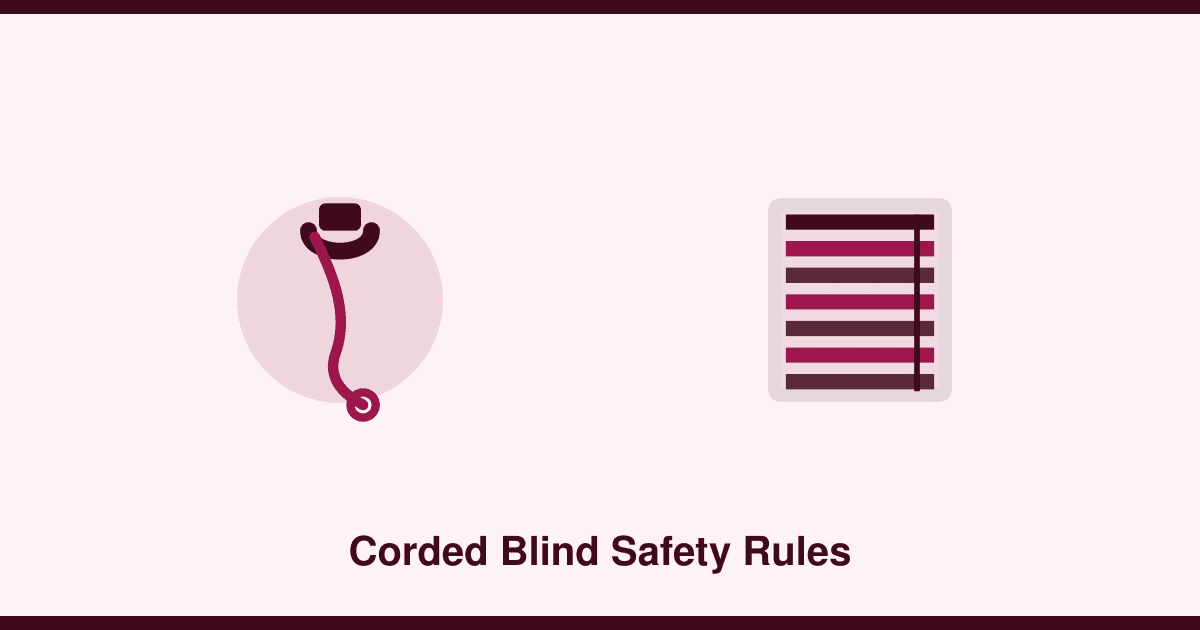
It surprises a lot of people to learn that the safety requirements around corded blinds and curtains in Australia are not a voluntary industry guideline but a mandatory standard with the force of law, enforced by the Australian Competition and Consumer Commission. The reason it exists is blunt and worth understanding rather than skimming past: loop cord systems on internal blinds and curtains are a recognised strangulation hazard for young children, who can become entangled in a looped cord left within reach, and the standard exists specifically to reduce the incidence of death and injury from this risk.
The mandatory standard applies to corded internal window coverings supplied in Australia from 30 December 2010 onward, under the Trade Practices (Consumer Product Safety Standard — Corded Internal Window Coverings) Regulations 2010. The core technical requirement is specific rather than vague: a corded internal window covering must be designed and supplied so that a loose cord cannot form a loop of 220 millimetres or longer at a height of less than 1,600 millimetres above floor level. That figure is not arbitrary, it reflects the reach and height of a young child able to climb toward a window, and it is the benchmark that safety devices on modern blinds are built around. Alongside the loop-length requirement, the standard requires a warning label on the retail packaging, a separate warning label attached to the corded product itself, and installation instructions that explain how to fit the safety device correctly.
A detail that catches some homeowners and even some tradespeople out is that the safety obligations do not stop at the point of sale. A second, related instrument, the Competition and Consumer (Corded Internal Window Coverings) Safety Standard 2014, came into effect in January 2015 and specifically covers the installation of corded internal window coverings. In practice this means an installer fitting a corded blind or curtain in a home has their own compliance obligations around fitting the safety device correctly, not just supplying a compliant product in the box, which is one of several reasons professional installation, rather than a DIY fit, is worth considering for corded coverings, particularly where the wording of the standard or the correct fitting of a specific safety device is unclear.
The practical safety devices you will typically see fitted to a corded blind include a cord cleat, a small wall-mounted hook the cord is wound around and secured well above a child's reach, and cord tensioning devices, which anchor the bottom of a looped cord to the wall or window frame so it cannot form a dangerous loop even if left unwound. For households with young children specifically, the most straightforward way to remove this risk altogether, rather than managing it, is to choose cordless or motorised blinds in bedrooms, nurseries and any room where children spend unsupervised time; this sidesteps the loop-cord hazard entirely rather than relying on a device being used correctly every time.
If you have older blinds or curtains in your home, particularly if they predate 2010 or were sourced second-hand, it is worth checking them against the loop-length requirement above and considering whether a retrofit cord cleat or tensioner, both inexpensive and widely available, would bring them up to a safer standard even if they are not legally required to be replaced. This is a reasonable, low-cost precaution rather than an overreaction, particularly in any room a young child has access to.
This article explains how the mandatory standard works in general terms; it is not legal advice, and the exact wording of the regulations should be checked directly with the ACCC's product safety website or a professional installer for anything you are unsure about. Our directory lists Australian blinds, shutters and curtain specialists by area if you need a professional to assess or fit compliant window coverings in your home.
Sources: productsafety.gov.au/business/search-mandatory-standards/blinds-curtains-and-window-fittings-mandatory-standard, accc.gov.au/media-release/accc-warns-of-dangers-of-loose-blind-and-curtain-cords, wsaa.au/child-safety.
Frequently asked questions
It is a mandatory standard, not a voluntary guideline, administered by the ACCC under the Trade Practices (Consumer Product Safety Standard — Corded Internal Window Coverings) Regulations 2010, applying to corded internal window coverings supplied in Australia from 30 December 2010.
A corded internal window covering must be designed so a loose cord cannot form a loop 220 millimetres or longer at less than 1,600 millimetres above floor level, along with mandatory warning labels on packaging and the product itself, plus installation instructions.
Yes. A separate instrument, the Competition and Consumer (Corded Internal Window Coverings) Safety Standard 2014, effective from January 2015, specifically covers installation of corded internal window coverings, meaning installers have their own compliance obligations around fitting the safety device correctly.
Choosing cordless or motorised blinds removes the loop-cord hazard entirely rather than relying on a cord cleat or tensioner being used correctly every time, which is why they are commonly recommended for bedrooms, nurseries and rooms where children spend unsupervised time.